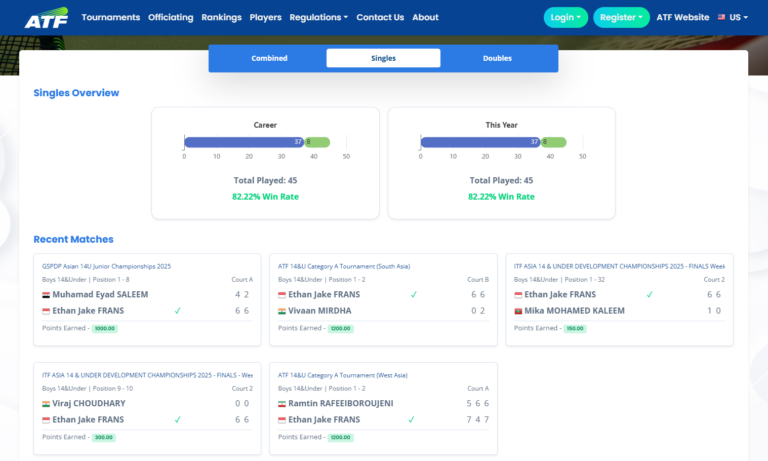
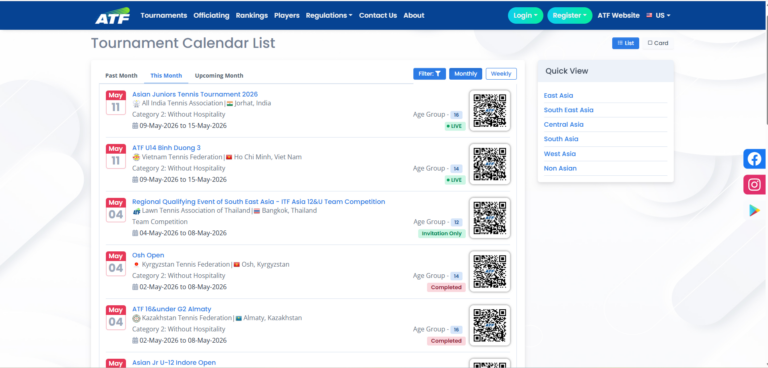
Asian Tennis Federation Rankings: How Points Become Weekly Rankings
If you’re a junior tennis player on the Asian circuit, your ranking determines almost everything about your competitive life. It decides which tournaments you’re accepted into. It decides whether you go straight into the main draw or have to qualify. It determines your seeding. It influences scholarships, federation funding, national team selection. Your ranking is, functionally, your competitive identity.
So it’s worth understanding how it actually gets calculated and published — because most players, parents, and even some coaches carry a vague mental model that goes “I won a match, I got points, I went up.” The real system is more interesting, and the details have practical consequences for how a player plans their season.
This article walks through the full pipeline using the Asian Tennis Federation (ATF) Asian Junior Rankings as the worked example. The general structure applies to most national and continental rankings, with the specifics varying federation by federation.
What “ranking” actually means
A ranking is just a sorted list. The ranking table for Boys 14 & Under — or for that matter any official age category — is at heart a list of players ordered by their point total: highest first, lowest last. The number you see (“ranked 23rd”) is just your position in that list. The math is plain; what’s interesting is what feeds into the math.
There’s one important regulatory layer to flag before we go further. According to the regulations of the ITF (International Tennis Federation), official rankings are not permitted for age categories 12 & Under. Specifically: at the Regional Federation level — bodies like ATF — U12 rankings cannot be officially published. At the Global level, U10 rankings are not allowed for any federation, regional or national. The reasoning is developmental — the ITF doesn’t want very young players reduced to a positional integer before the competitive structure is meaningfully comparable.
To fill that gap, WTN (World Tennis Number) is used as a non-numeric standings indicator — a development tracker for the youngest brackets, without the positional weight of a ranked list. A 10-year-old playing competitive matches still gets a measurable number; it’s a WTN rating, not a ranking position.
Categories: many rankings, not one
Players don’t have a ranking. They have many.
For age categories where official rankings are allowed (U14 and above), the Asian Tennis Federation publishes ranking tables across the following:
- Boys 14 & Under
- Girls 14 & Under
- Boys 16 & Under
- Girls 16 & Under
- Senior categories — across formats
Internally these are stored as separate categories with short codes — Boys 14, Girls 14, Boys 16, Girls 16. When you look at “the rankings page,” you’re really looking at one specific category at a time.
The idea behind having a separate ranking for each defined age category is to allow players competing in that bracket to attain ranking points specifically for the bracket. This is what makes seeded draws possible — proper seedings derive from the bracket-specific rankings rather than from a single league-table-style number.
How Junior rankings actually combine Singles and Doubles
At the Junior level, all rankings are Singles Combined rankings. That doesn’t mean Doubles results are ignored — it means they’re folded into a single Singles ranking via a weighted contribution. Specifically: 100% of a player’s Singles points and 25% of their Doubles points from each tournament accumulate into the player’s Singles Combined ranking.
For example: if a player earns 100 points in the Singles event and 100 points in the Doubles event of the same Under 14 tournament, the Singles Combined points credited for that event are 100 + (100 × 25%) = 125 points. These points remain valid for a 52-week rolling window.
A practical implication for how the codes work: BD14 (“Boys Doubles 14 & Under”) and similar codes refer to event categories, not separate ranking lists. There’s no standalone Doubles ranking at Junior level. Acceptance and seeding for a BD14 event use the player’s Under 14 Singles Combined ranking — the same one used to seed BS14 events.
What about U10 and U12?
Below U14, the picture shifts. As covered above, U10 and U12 categories don’t have official ranking tables at the regional level — per ITF regulations. Instead, federations and platforms use WTN-based standings for player-development tracking. A 10-year-old who plays competitive matches still receives a measurable number, but that number is a WTN rating, not a ranking position. This makes WTN the de facto standings system for the youngest competitive brackets — both within a federation and across them.
One more thing follows from how the system works — what happens when a player ages up:
- When a player ages up (turns 15 and moves from U14 to U16), their U14 ranking history doesn’t transfer as their headline number — the new category starts fresh. However, ATF does give a head start. 20% of the points accumulated in Under 14 (the outgoing category) carry over as “Warm Up points” when the player enters Under 16. These Warm Up points are automatically removed after 6 months, so they cushion the transition without permanently distorting the new category’s rankings.
Points: where they come from
A player earns points by playing in sanctioned tournaments. Each tournament has a grade, and each grade has a points table that says: winner gets X points, runner-up gets Y, semi-finalist gets Z, quarterfinalist gets W, and so on down to a small consolation amount for first-round losers.
So the input to a player’s point total is simple: every sanctioned event they played, their result in that event, and the points associated with that result (applying the 100% Singles + 25% Doubles weighting for Junior categories, as covered above).
In ATF, the points table is graded — Grade 1 events deliver more points than Grade 4 events. A player who reaches the semifinal of a Grade 1 might earn more points than the winner of a Grade 4. This is what makes higher-grade tournaments worth more for player development: not the prize money — the points.
The “best of N” rule
Here’s the part most casual readers don’t realise: a player’s ranking points usually aren’t the sum of every event they played. Most federations use a “best N” or “top N” rule.
For ATF, the convention is the player’s top six results in the relevant category — drop the rest. So if a player entered ten tournaments in a 52-week rolling window, only the six best results count toward their ranking. The other four don’t actively hurt; they just don’t contribute.
The reason this rule exists is to prevent ranking inflation through volume. Without it, a player who entered 30 events would beat a player who entered 8 events even if the eight-event player had stronger results in each. Top-N counting rewards quality over quantity.
It also has a practical consequence for season planning: there’s a point at which entering one more event adds nothing to your ranking. If your top six results are all stronger than what you can realistically achieve from one more weekend’s tournament, that weekend is for development, not ranking. Coaches build calendars around this.
Bonus points and special rules
Beyond the age-up Warm Up points covered earlier, ATF has a few other edge-case rules worth knowing:
- ITF event bonuses: results from ITF World Tennis Tour Junior events count toward ATF rankings, with grading rules.
- Penalty points: a player can lose points (or have points withheld) for things like late withdrawal after the freeze deadline, no-show at the event, or disciplinary issues. These — along with the Warm Up points mechanics, the points-table grading, and the Singles Combined weighting — are codified in the ATF 14 & Under Regulations 2026 PDF, which federation administrators reference constantly when fielding queries from parents and coaches.
- Inactivity decay: in some systems, points from older events lose value over time. ATF works on a 52-week rolling window for most categories — points earned more than 52 weeks ago drop off entirely. This is a strong incentive for players to keep entering events; a “ranking holiday” of a few months can have visible consequences.
The weekly cycle: how rankings actually update
Tennis rankings are usually published weekly, not in real time. Why? Because publishing a ranking that updates every time a single match finishes would create chaos — acceptance lists couldn’t stabilise, seeding would shift mid-tournament, and operational teams couldn’t trust any snapshot.
So the cycle is:
- Monday → Sunday: tournaments run. Results entered into the platform throughout the week.
- End of Sunday (or early Monday): the ranking system snapshots all results from the past week and earlier, applies the points table to each, applies the “best six” rule and the Singles Combined weighting, and computes new totals for every player in every category.
- Monday morning: new rankings published. Acceptance lists for tournaments using next week’s rankings now refresh with the new data. Seedings for events held later that week are calculated from the new snapshot.
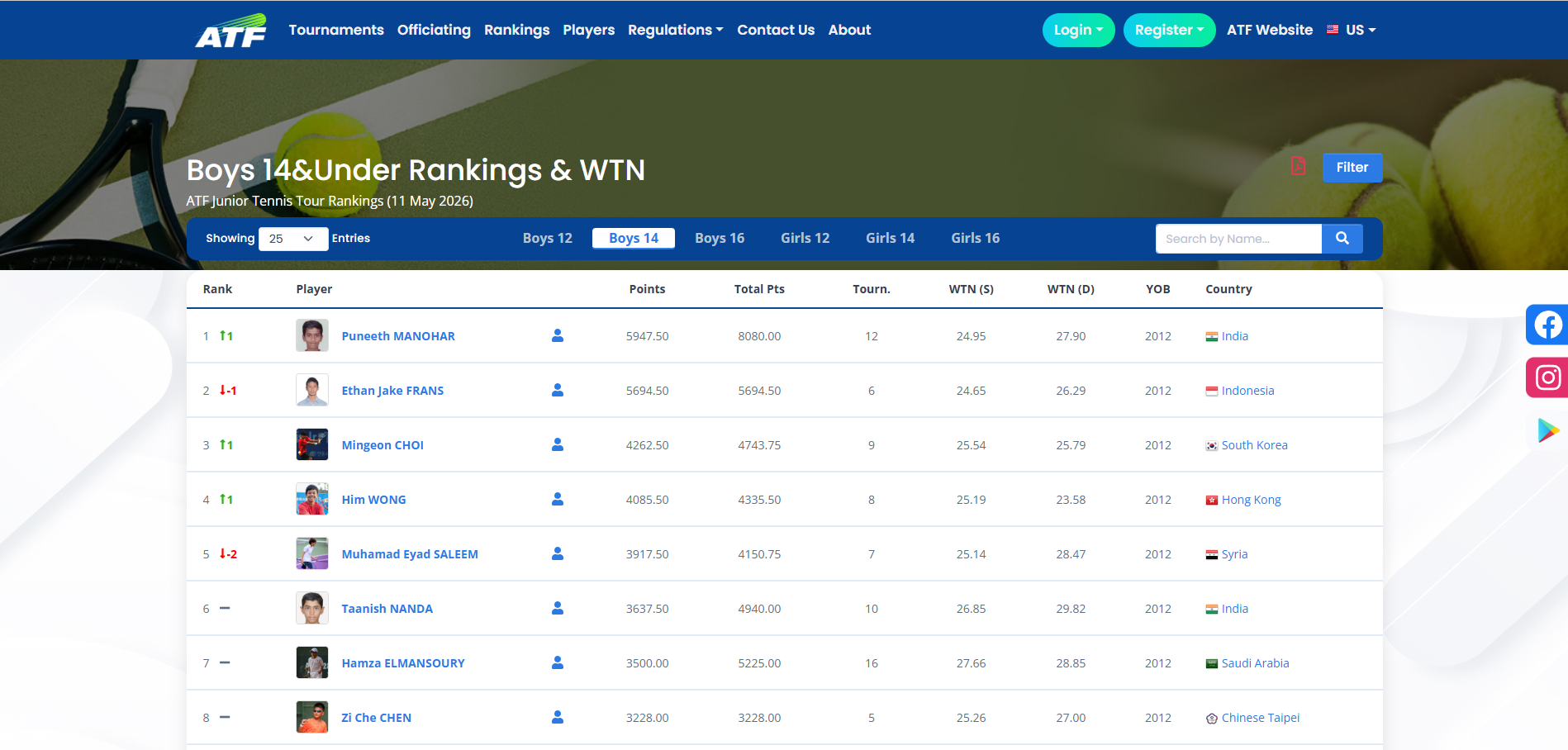
- The “week-of date”: internally, every ranking row is tagged with the Monday of the week it represents. So when you look at “Boys 14 & Under, week of 11 May 2026,” you’re looking at the ranking that was published on Monday 11 May, reflecting all results through Sunday 10 May.
This is why federations are strict about result entry deadlines. If an organiser uploads a result late, that result might miss the Monday cutoff and not appear in this week’s ranking — it’ll appear next week. For players whose acceptance into another event depends on the ranking, this matters a lot.
Rank movement: up or down
The published ranking page on most platforms shows not just the rank itself but a rank movement indicator — an up-arrow, down-arrow, or no-change icon, often with a number (“up 4 places this week”).
That’s calculated by comparing the current week’s rank to the previous week’s rank for the same player in the same category. The arrow up means the player gained places; the arrow down means others gained on them, or they lost points (an old result dropping off the 52-week rolling window can cause a drop even if the player did nothing wrong that week).
This is why rankings can move even on weeks where you didn’t play. If a result from 53 weeks ago drops off your record this Monday, your point total is recalculated, and you may move down the table — purely because the calendar advanced.
What about WTN?
WTN (World Tennis Number) is a parallel system run by the ITF. It’s different from federation rankings in two ways:
- Rankings are positional within a category — “you are 23rd in Boys 14 & Under in Asia.”
- WTN is a numeric rating from 1 (best) to 40 (developing), based on match results across all formats and ages, computed from match outcomes regardless of tournament grade. It’s designed to be globally comparable.
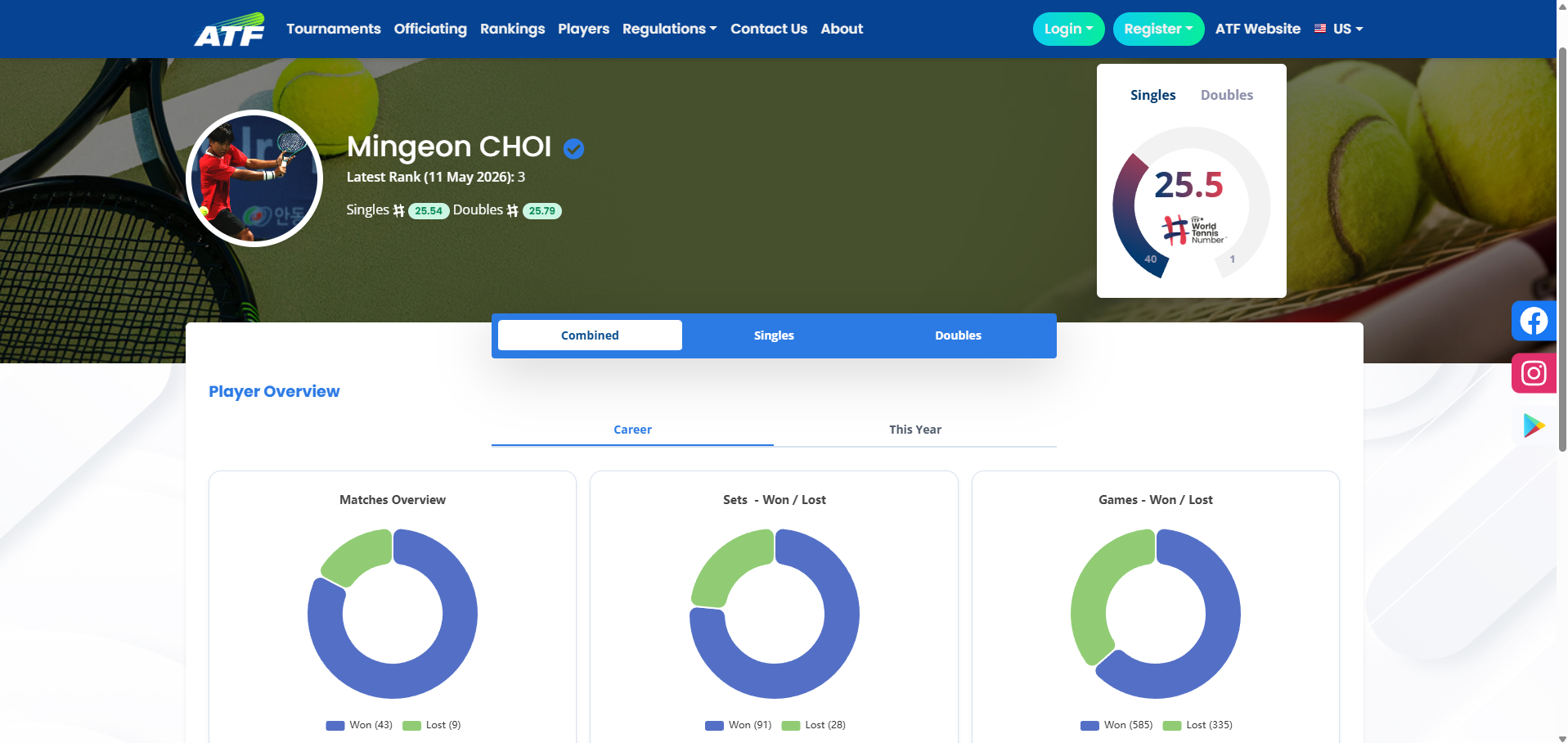
Modern federation platforms like HitCourt display both on each player profile — the federation ranking for the player’s primary category, plus WTN singles and doubles numbers as cross-federation context. This gives credence to a player’s positioning at a National, Regional, or Global level — a number that lets a 14-year-old in Vietnam be compared meaningfully to a 14-year-old in India or in Thailand.
Practical take-aways for players and parents
A few things follow from how the system works:
- Quality > quantity. Entering 25 events doesn’t beat entering 10 strong events. Plan the calendar around the best six.
- Don’t chase a single big result. A semifinal at Grade 1 stays in your top-six for 52 weeks — but a string of consistent quarterfinals across the season ages more gracefully than one breakthrough event, because every result holds independently in the top-N pool.
- Watch the freeze date. Withdrawing after the freeze deadline can cost ranking points and possibly attract a fine.
- Plan around age-ups. When a player is approaching a category transition (turning 13, 15 or 17), the season after the transition is a partial rebuild. The Warm Up points cushion the first six months — smart families plan strong events in the new category early, while the carryover is still in effect.
- Check the rankings page on Mondays, not Wednesdays. Mid-week snapshots are stale.
Where it all comes together
A ranking number isn’t just a position. It’s the encoded summary of a year of decisions — which events to enter, which to skip, when to withdraw, when to push, when to rest. The player’s ranking on any given Monday reflects all of those choices, plus the operational reliability of the federation’s results pipeline.
When the system works well — clean entry, accurate results upload, reliable Monday publication — players can trust the number, and the trust extends to coaches, parents, and federations using it for selections. When the system is unreliable, players stop trusting it, and the political pressure on the rankings desk gets uncomfortable.
It’s worth getting right.
Further reading
- Live Asian Tennis Federation rankings — browse the current week’s published rankings across all official categories.
- Sample player profile (Mingeon CHOI, ATF rank 3, 14U) — see how rankings and WTN are presented side-by-side on a live player record.
- ATF 14 & Under Regulations 2026 (PDF) — the formal regulation document covering Warm Up points, points-table grading, Singles Combined weighting, and penalty points referenced above.