What Makes a Great Tournament Factsheet — and Why Players Notice
Ask any tournament organiser which page on the federation website matters most and you’ll hear “the homepage” or “the rankings.” Pull the actual analytics, and a different answer wins by a wide margin: the tournament factsheet pages. Players read them. Parents read them. Coaches read them. Officials read them. Travel agents booking flights for visiting families read them.
A factsheet is not a brochure. It’s a contract between the organiser and everyone about to commit time and money to attending the event. When it’s clear, complete and accurate, entries arrive. When it’s vague, contradicts itself, or leaves fields blank, entries drop — and the tournament desk fields a flood of questions instead.
This piece is a practical breakdown of what a great factsheet contains, why each field exists, and the recurring mistakes that cost organisers entries — drawing on patterns from Asian Tennis Federation (ATF) events and other federations across Asia.
Who reads a factsheet, and what they need
A great factsheet has to serve four very different audiences from a single page, without becoming cluttered for any one of them. Each reader extracts a different set of information; the discipline is to surface all of it cleanly.
The player wants to know: when does it start, where, what surface, what ball, will I be eligible, can my coach come, how much does it cost, and when do I have to commit by? They scan top-to-bottom in about thirty seconds and decide whether to read further.
The parent wants to know: travel windows (arrival and departure), accommodation arrangements, hospitality coverage if any, total cost, who to contact if something goes wrong, and whether the venue is safe to send their child to.
The coach wants to know: surface and ball, court count and condition, practice court availability, hospitality for coaches, schedule (so they can plan multiple players’ weeks), and category (which determines whether it’s worth their player’s time).
The official wants to know: organiser contact, on-site referee, host federation, tournament type (junior or senior, individual or team, qualifying or main only), and operational details that affect umpiring assignment.
If the factsheet only serves the player, the others bounce.
The non-negotiable fields
Every factsheet must contain the following. A short note on why each matters.
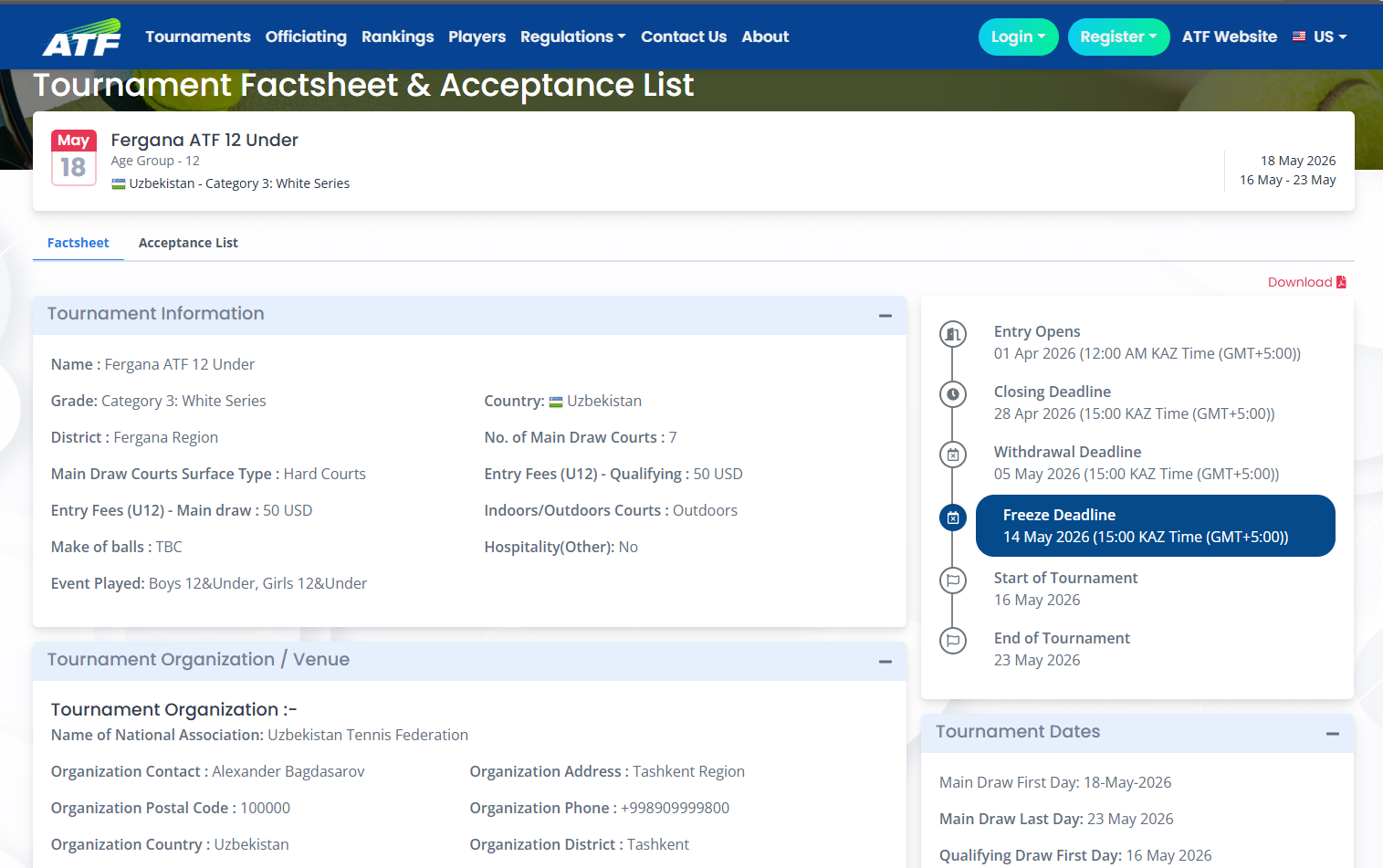
Tournament Name (full, official). Use the exact official name as sanctioned by the federation. “ATF U14 Asian Junior Circuit Category 2 — Bangkok” is better than “Bangkok Junior Tennis Open.” Players search by official name.
Category. The federation Category (Category 1, Category 2, Category 3, Team Competition, and so on) tells experienced players how strong the field will be and how many points are on offer. ATF circuits run on the Category system; “Grade” appears synonymously across some federations and ITF-level documentation. Without a Category, players don’t know whether to enter. For how Category points flow into the weekly ranking computation, see the companion piece on how Asian Tennis Federation rankings work.
Country, City, District, Venue. Players need this to plan travel. The district matters because some cities have multiple tennis venues and players have to know which one. “Bangkok” alone is not enough; “Bangkok — Nonthaburi District, [Venue Name]” is.
Start Date and End Date (with the week-of date). The “week-of” Monday date is what most circuits use as the canonical reference for everything that follows — points, rankings, scheduling. It should appear prominently.
Tournament Type. Individual or Team Competition. Singles only, or singles + doubles. Junior, senior, or veterans. This filters out players who shouldn’t be entering and clarifies expectations.
Age Categories Played. List every age category as a labelled chip: Boys 12 & Under, Girls 12 & Under, Boys 14 & Under, and so on. A player who plays U14 should immediately be able to see whether their age category is offered.
Number of Main Draw Courts. Tells the coach how many matches can run simultaneously, which affects schedule density and how long the player might wait between matches.
Court Surface. “Hard Court,” “Clay,” “Synthetic Grass,” “Carpet.” Surface fundamentally changes how a player prepares — shoes, racquet tension, hydration, even strategy. This is non-negotiable information.
Indoors / Outdoors. Affects warm-up, weather contingency, and ball behaviour. Some players strongly prefer one over the other.
Ball Used (Make and Model). “Dunlop Fort All Court” or “Wilson US Open.” Different balls play differently. Coaches plan match prep around the ball.
Entry Open Date / Time. Specific timezone and time of day. Players have to enter the moment the window opens for popular events.
Entry Deadline (Closing) Date / Time. Specific timezone. Hard deadline. Late entries either rejected or charged a late fee.
Withdrawal Deadline. The last date a player can withdraw without penalty. After this, ranking points and fines may apply.
Freeze Deadline. The moment the acceptance list is finalised and no further movement is possible. After this, alternates only move via on-site sign-in.
Entry Fees. By age category, separated by qualifying and main draw where applicable, in clear currency (USD is most common for international circuits).
Hospitality Details (if any). Whether the event is a “Hospitality” or “Without Hospitality” tournament. If hospitality is provided: what’s covered (accommodation, meals, transport, coach hospitality), arrival and departure dates.
Arrival and Departure Dates. For hospitality events, these are the dates between which the organiser will accept the player. Critical for booking flights.
Organiser Contact. Email and phone of the responsible person — the host federation tournament desk. Players will need to reach them.
Sanctioning Authority Logos. ATF logo for ATF events. ITF logo if it’s an ITF Junior World Tour event. National federation logo. These visual cues build trust.
What separates a great factsheet from a complete one
A complete factsheet has all the fields above. A great factsheet does three more things.
1. It uses consistent language. “Closing Date,” “Closing Deadline,” “Entry Deadline,” “Last Date to Enter” — pick one and use it everywhere on the page. Inconsistent labels create confusion and tickets for the tournament desk.
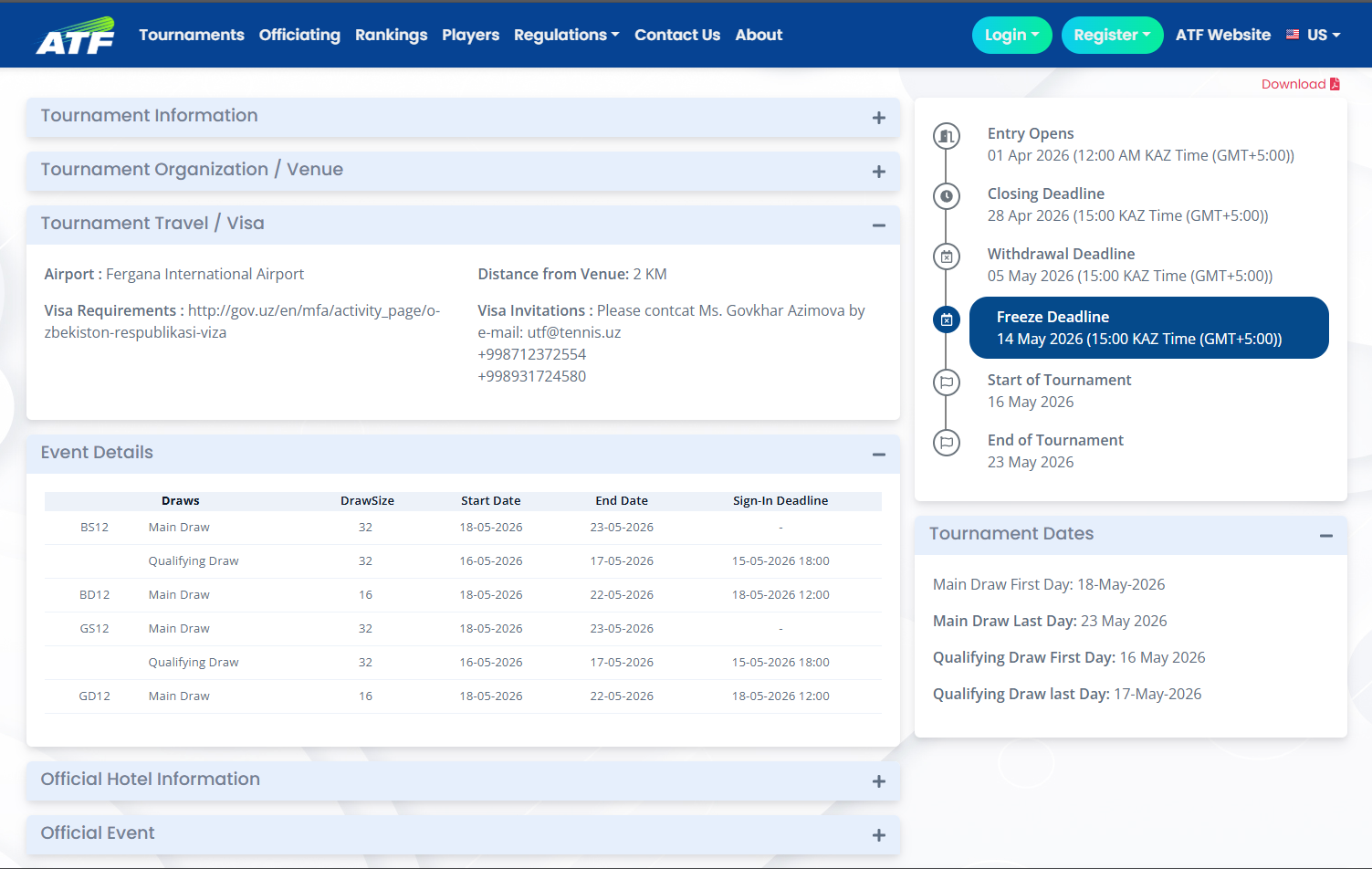
2. It states the timezone explicitly. “15:00 KAZ Time (GMT+05:00)” is good. “3 PM” is not. KAZ Time is ATF’s standard reference timezone for tournament deadlines — players across the continent (Japan, India, UAE, Thailand, Hong Kong) operate on different local times, and ambiguous deadlines lead to missed entries.
3. It links to deeper detail without dumping it on the main view. The factsheet should expand into Organisation/Venue, Travel/Visa, Event Details, and Hospitality on separate, lazy-loaded sections. The main page stays scannable; the deeper details are one click away. This is how the modern HitCourt factsheet view is structured — the headline information renders immediately, and operational sub-sections expand on demand.
The mistakes that cost organisers entries
Across the thousands of factsheets we’ve seen pass through the platform, the same handful of mistakes recur — and each one visibly costs the tournament entries. The recurring ones:
The factsheet is published late. If a Category 1 event publishes its factsheet two weeks before entry opens, players have already filled their calendar. The factsheet should be published 6–8 weeks before entry opens.
The surface or ball changes after publication. This destroys trust faster than anything else. Once a coach has prepared a player for clay, telling them the event is now hard court is operationally close to a betrayal. If a change is genuinely unavoidable, communicate it clearly with as much notice as possible, and compensate by allowing low-cost withdrawals.
The entry fee is buried. Some factsheets put the entry fee in fine print. Players need to see it immediately — they’re budgeting their season, and they need the number on first scan.
Hospitality details are vague. “Hospitality available” without specifics is worse than saying “no hospitality.” Be specific: which days, which meals, who’s covered, who pays.
Contact info is generic. “info@nationalfederation.org” doesn’t tell the player who specifically handles tournament queries. A named person or a dedicated tournament inbox gets faster response and better experience.
The tournament name on the factsheet doesn’t match the calendar listing. Sounds trivial, but players search and bookmark by name, and inconsistencies cause “is this the same event?” confusion.
The factsheet as an SEO and discovery surface
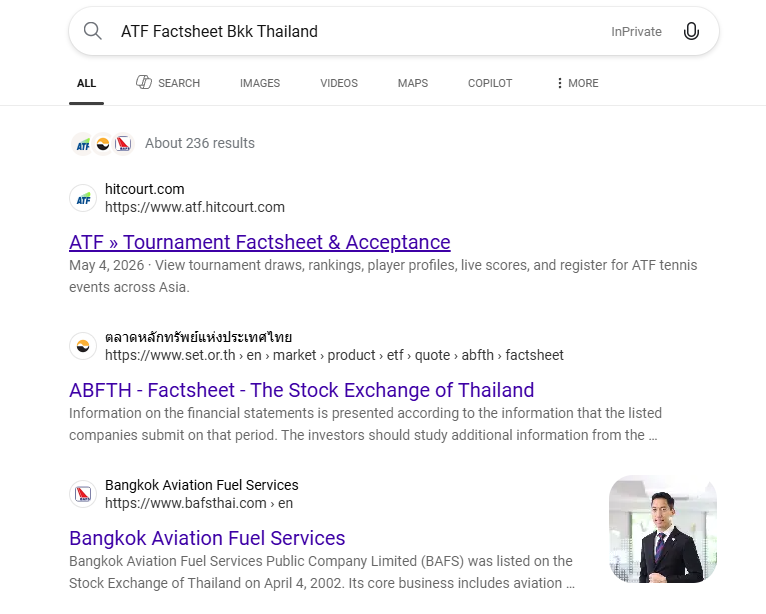
Here’s where most organisers underestimate the factsheet: a meaningful share of its traffic doesn’t come from the federation’s homepage at all. It comes from Google. A player typing “ATF Bangkok 14 and under May 2026” into search lands on the factsheet directly, often before they’ve ever clicked anywhere else on the federation site. Whether that search delivers them depends on three boring details — a clear <title>, a substantive first paragraph, and structured data describing the event (SportsEvent JSON-LD). Get those right and the factsheet ranks; get them wrong and a third-party listing or forum takes the traffic.
This matters for:
- New players discovering events for the first time.
- Travelling players and parents who don’t have the federation site bookmarked.
- Journalists and aggregators who write about junior tennis events.
- Sponsors and media partners assessing the event’s profile.
Modern federation platforms (including HitCourt’s) generate this metadata automatically from the factsheet’s structured fields. But it only works if the structured fields are filled in correctly to begin with — which loops back to the boring, important point: the factsheet is only as good as the discipline of the person filling it in.
A practical checklist for organisers
Before publishing a factsheet:
- Read it as a player. Can you tell what the event is, where, when, what surface, what ball, what age categories, what fees, what deadlines — in under 60 seconds?
- Read it as a parent. Can you tell what the total cost will be (entry + travel window + accommodation if not hospitable), and when you’d need to arrive and leave?
- Read it as a coach. Can you tell whether the event is worth your player’s time, what to prepare for, and whether you’re welcome on site?
- Read it as an official. Can you tell who’s running the event and where the venue is?
- Are all timezones explicit?
- Is the contact email a specific named address?
- Are sanctioning logos present?
- Are hospitality terms specific?
If all eight pass, you have a great factsheet.
In summary
The factsheet is not a marketing page. It’s an operational document with downstream consequences for entries, trust, and the tournament desk’s workload. Get it right and the draw fills itself. Get it wrong and you spend the next four weeks answering emails and re-explaining what should have been on the page.
The best organisers treat the factsheet with the same care they give the on-court schedule. That’s how it earns its place as the most-read page on the federation site.
Further reading
- Live Asian Tennis Federation tournament calendar — browse the current events and click through to live factsheets.
- Asian Tennis Federation Rankings: How Points Become Weekly Rankings — the companion piece on how Category points flow into the weekly ranking publication.
- ATF 14 & Under Regulations 2026 (PDF) — the formal regulation document covering Category hierarchy, entry windows, freeze deadlines, and the regulatory layer the factsheet enforces.