How a Junior Tennis Player’s Career Is Tracked Across Categories
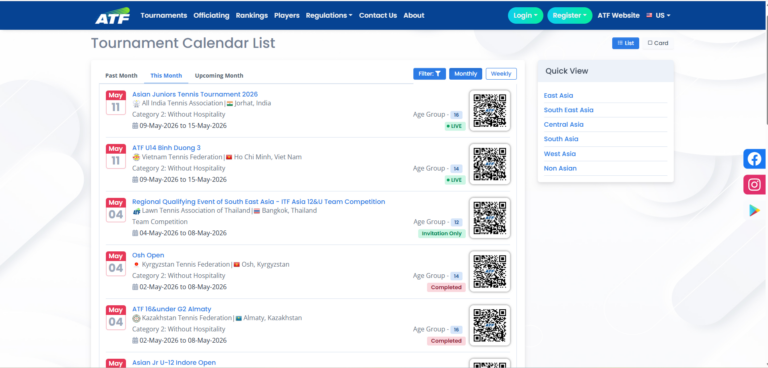
A junior tennis career — from first sanctioned event to the last tournament before the player turns senior — runs roughly seven years. In that span, a player moves through age categories (Under 12 → Under 14 → Under 16), accumulates match data, builds rankings in multiple disciplines, and assembles a public-facing profile that follows them from federation to federation, platform to platform, and into the senior game.
For most parents and coaches encountering this data for the first time, it can feel like reading a foreign language: dozens of fields, multiple rankings, codes for events, scoring abbreviations. This piece unpacks how federations actually structure a junior’s record, what data points matter at which stages, and how to actually read the information once you find it.
We’ll use the Asian Tennis Federation (ATF) junior pipeline as the worked example throughout.
The player record: what it actually contains
When a player registers with a federation for the first time, the platform creates a permanent record. Six fields form the foundation:
- Member ID — a permanent identifier that follows the player throughout their career. Even if their name, country or coaching changes, the ID doesn’t.
- First name, family name — display name on rankings, draws, profiles.
- Date of birth — drives category eligibility (you have to be born in or after a certain year to play U14, etc.).
- Country / nationality — drives federation affiliation and flag display.
- Profile photo (optional but useful for recognition).
- Gender — drives Boys/Girls category assignment.
That’s the foundation. Everything else is derived: rankings, match histories, tournament participation, head-to-head records.
Category eligibility: why birthdate is non-negotiable
ATF junior categories are based on birth year, not on when you start playing:
- Under 12: typically players born in the relevant 12-and-under birth-year window for the season.
- Under 14: the next two-year window.
- Under 16: the next two-year window.
- Senior: the year a player ages out of U16 they become eligible for senior events; typically they continue playing both U18 (if their federation runs it) and senior simultaneously.
One important nuance about “playing up”: a 12-year-old isn’t restricted to U12 events. Entering U14 events to develop against stronger competition is a globally acknowledged practice in junior tennis — the same instinct as a parent wanting their child to sit next to the brightest student in class. It’s not a formal cross-federation policy; it’s an accepted developmental convention. The reverse — a 14-year-old entering U12 events — is not allowed.
Birth year is what the platform uses to compute eligibility. A factsheet that says “Boys & Girls 14 & Under” maps to specific birth years. Operations teams calculate the cutoff and the platform either allows or rejects entries automatically.
How rankings track a player across categories
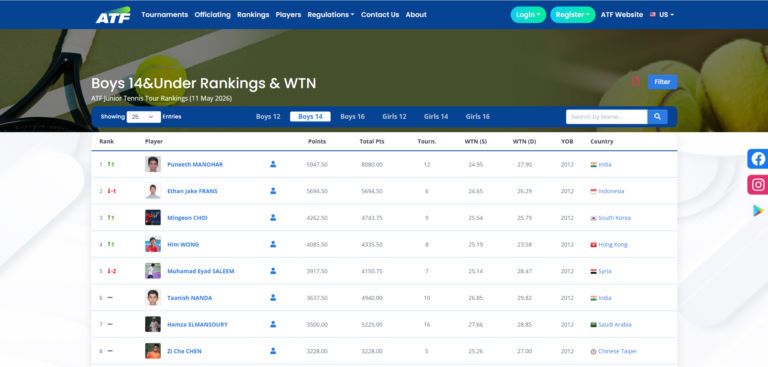
A junior player isn’t ranked once. They’re ranked separately in each category they play, and those rankings move independently:
- Singles rankings in their primary category.
- Doubles rankings are folded into the Singles Combined ranking at Junior level (100% Singles + 25% Doubles).
- Rankings in adjacent categories if the player plays up — e.g., a strong U12 player who enters U14 events earns U14 ranking points and gets a separate U14 ranking, even while their development in U12 continues.
One regulatory note worth flagging upfront: per ITF regulations, the Asian Tennis Federation does not publish official Under 12 rankings — regional federation bodies are not permitted to. Below U14, WTN-based standings (covered below) carry the development picture instead. So a player’s strict “ranking story” at ATF begins at U14, though the platform records all junior match data from first sanctioned event onwards.
For categories where rankings are published (U14 and above), a player’s “ranking story” is multi-dimensional. You don’t just say “she’s ranked 23rd”; you say “she’s 23rd in Boys 14, 67th in Boys 16, etc.” Coaches and selectors look at all of these together to assess where the player is at competitively.
When a player ages up — say from U14 to U16 at the start of the new season — their U14 ranking stops updating (they can no longer enter U14 events). Their U16 ranking takes over as the primary. Most federations provide some bonus-point carryover so the player doesn’t restart from zero. ATF’s specific mechanic is called Warm Up points: 20% of the player’s accumulated U14 points carry over into U16 for the first 6 months. Other federations are open to copy the regulation; some have their own variants. The full mechanics — including how points percolate, what happens at age-up, and the 52-week rolling window — are covered in the companion piece on how Asian Tennis Federation rankings work.
Match histories: the most underrated dataset
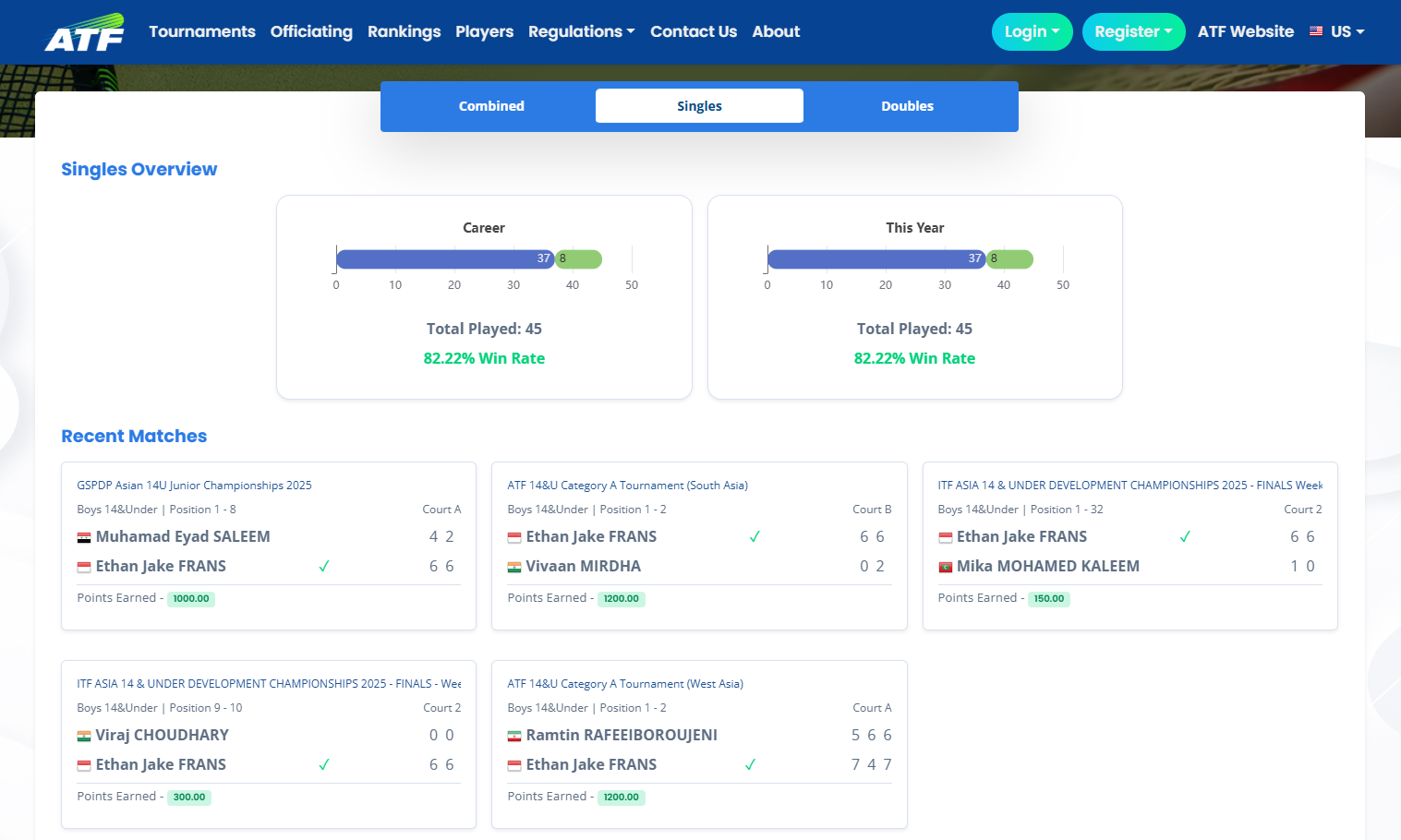
Beyond rankings, the player’s record holds every match they’ve played in sanctioned events. The data enters the record during tournament results upload — when the operations team does it right, every score, every score-line, every retirement code is captured faithfully. When they don’t, the player’s career story has holes in it.
Each match record typically includes:
- Tournament name and date.
- Opponent’s name and country.
- Round (R128, R64, R32, R16, QF, SF, F).
- Score in standard format (e.g., 6-4, 6-2 or 7-6(3), 4-6, 7-5).
- Match duration in some platforms.
- Surface and ball (sometimes derived from tournament metadata).
- Win/loss flag for the player.
Aggregated, this becomes a powerful tool. A coach looking at a player’s match history can see:
- Win rate by surface. Does this player win more on hard than on clay?
- Win rate by round. Does she consistently make quarterfinals but lose there? That’s a different problem from a player who loses in round one.
- Performance against specific opponents. Head-to-head records emerge — “this player has played that one four times, won three.”
- Streaks and slumps. A run of first-round losses might indicate burnout, an injury, or a coaching transition.
- Improvement curves. Win rate against players ranked 20+ above is a leading indicator of upward movement.
When match data is complete and accurate, it’s one of the most valuable development tools available. When it’s spotty — missed entries, missing scores, retirement codes that don’t capture what happened — the analysis suffers proportionally.
Head-to-head: the rivalry data
Out of the match history, federations and platforms surface a specific subset: head-to-head records between specific player pairs.
A head-to-head between Player A and Player B contains:
- Total matches played.
- Wins for A.
- Wins for B.
- Date and event of each match.
- Surface of each match.
- Score line of each match.
Coaches use head-to-head extensively. If a player is drawn against someone they’ve played before, the coach pulls the head-to-head and walks through what happened, what worked, what didn’t. For the player about to step on court for a fourth meeting against the same opponent, this data is the closest thing junior tennis has to scouting reports.
Modern federation platforms make head-to-head a one-click view from the player’s profile. HitCourt’s head-to-head implementation on the ATF deployment is on the platform roadmap; for now, head-to-head context is reconstructed manually from the player’s match history view.
WTN (World Tennis Number): the parallel rating
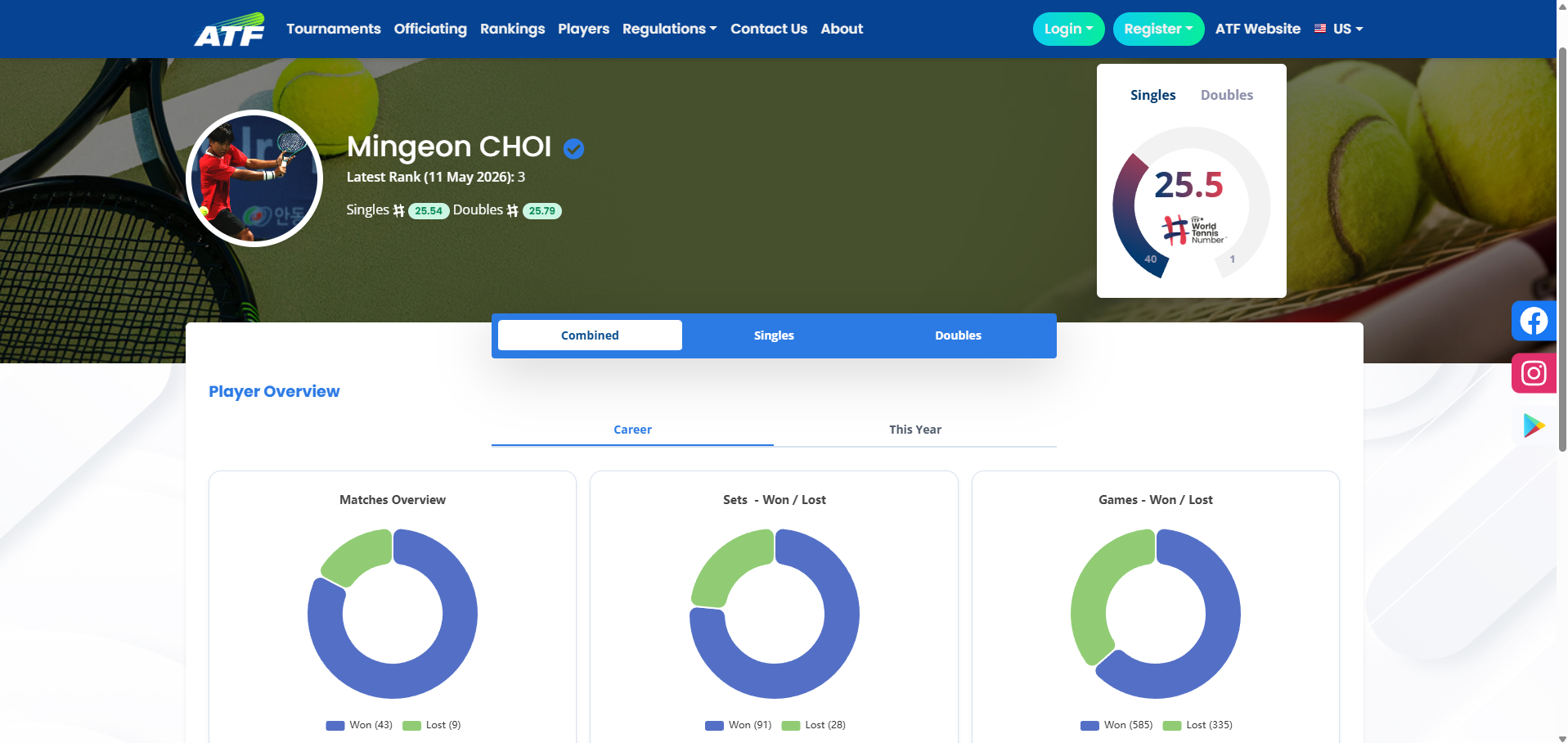
Alongside federation rankings, most modern player profiles also display the player’s WTN — World Tennis Number, the ITF’s universal rating system.
WTN is structurally different from a federation ranking:
- It’s a rating (1 to 40+, lower is better) not a position (you’re not “ranked 23rd in WTN,” you’re “rated 14.6”).
- It’s globally comparable — a 14-year-old in Asia and a 14-year-old in Europe with the same WTN are roughly equivalent in playing strength.
- It updates more frequently (sometimes daily) and accounts for individual match outcomes regardless of grade.
Player profiles on platforms like HitCourt typically display WTN-Singles and WTN-Doubles alongside the federation ranking. The two systems serve different purposes: federation ranking for eligibility, seeding and selection within the federation; WTN for cross-federation comparison and matchmaking.
The junior-to-senior transition
The most consequential moment in a junior career is the transition to senior tennis. For ATF, this happens around age 17–18 when the player ages out of U16.
What changes:
- The player’s junior rankings stop updating for any age group they’ve aged out of.
- They start playing ITF World Tennis Tour senior events if they’re at that level, building ATP/WTA points.
- Their rating systems shift — WTN continues; junior-only ranking stops.
- Their match history continues as a single timeline; senior matches simply join the junior matches in chronological order.
- Their player profile stays at the same URL on the federation platform — the data continues, the categories shift.
This transition is psychologically and developmentally hard. A player who was top-3 in U16 in their region might be ranked 800 in senior events for the first year. The match data doesn’t lie — junior wins don’t transfer. But the platform’s record of their junior career remains as the foundation. A senior recruiter looking at a player’s senior debut year reads it in the context of what the junior years showed — every score, every comeback, every breakthrough is still there. The data doesn’t reset; only the leaderboards do.
Why parents should understand the data
A few practical implications fall out of all this:
- Check the player profile after every tournament. Make sure the results uploaded correctly. Errors happen — a missed match, a wrong score, a withdrawal coded as a loss. They’re easier to fix in the week after the event than months later.
- Don’t fixate on a single ranking number. The full picture is in the multi-category rankings, the match history, and the WTN. A player ranked 47th but with strong wins over players ranked 15–20 is moving up; a player ranked 22nd losing first round consistently is moving down even if the rank hasn’t reflected it yet.
- Reconstruct head-to-head before key matches from the match history (until platform-side head-to-head views land). Coaches do this routinely; parents can too. A daughter facing the same opponent for the third time has data to draw on.
- Track win rate by surface. If your player is consistently better on hard than on clay, prioritising hard-court events in the calendar makes sense. If she wants to develop her clay game, schedule clay events deliberately even if the points are smaller.
- Plan for the age-up. The season after an age-up is rebuild season. Don’t expect ranking continuity. Plan strong events early to put Warm Up points to use while they’re still in effect.
The platform’s responsibility
For all of this to work, the federation’s platform has to be diligent about three things:
- Profile data integrity. The Member ID, name, DOB, country must stay consistent forever. Renames, country changes (rare but possible), and corrections must be handled carefully.
- Match data completeness. Every match in every sanctioned event must enter the player’s record. Missing matches mean head-to-heads are wrong, win rates are wrong, ranking points are wrong.
- Public profile accessibility. The player profile page should be easy to find (search by name, search by Member ID), easy to share, and complete in what it shows.
When the platform takes this seriously, the player profile becomes the single source of truth for the junior career. Parents check it, coaches reference it, federations use it for selections, and the player herself watches her career compose in real time.
In summary
A junior tennis career is a multi-year story written in categories, rankings, match histories, and a global rating — assembled by the federation’s platform into a single profile that follows the player through their development. Understanding what’s tracked, where, and why is the difference between using the data and treating it as a black box. The data is rich and meaningful. It’s worth learning how to read it.
Further reading
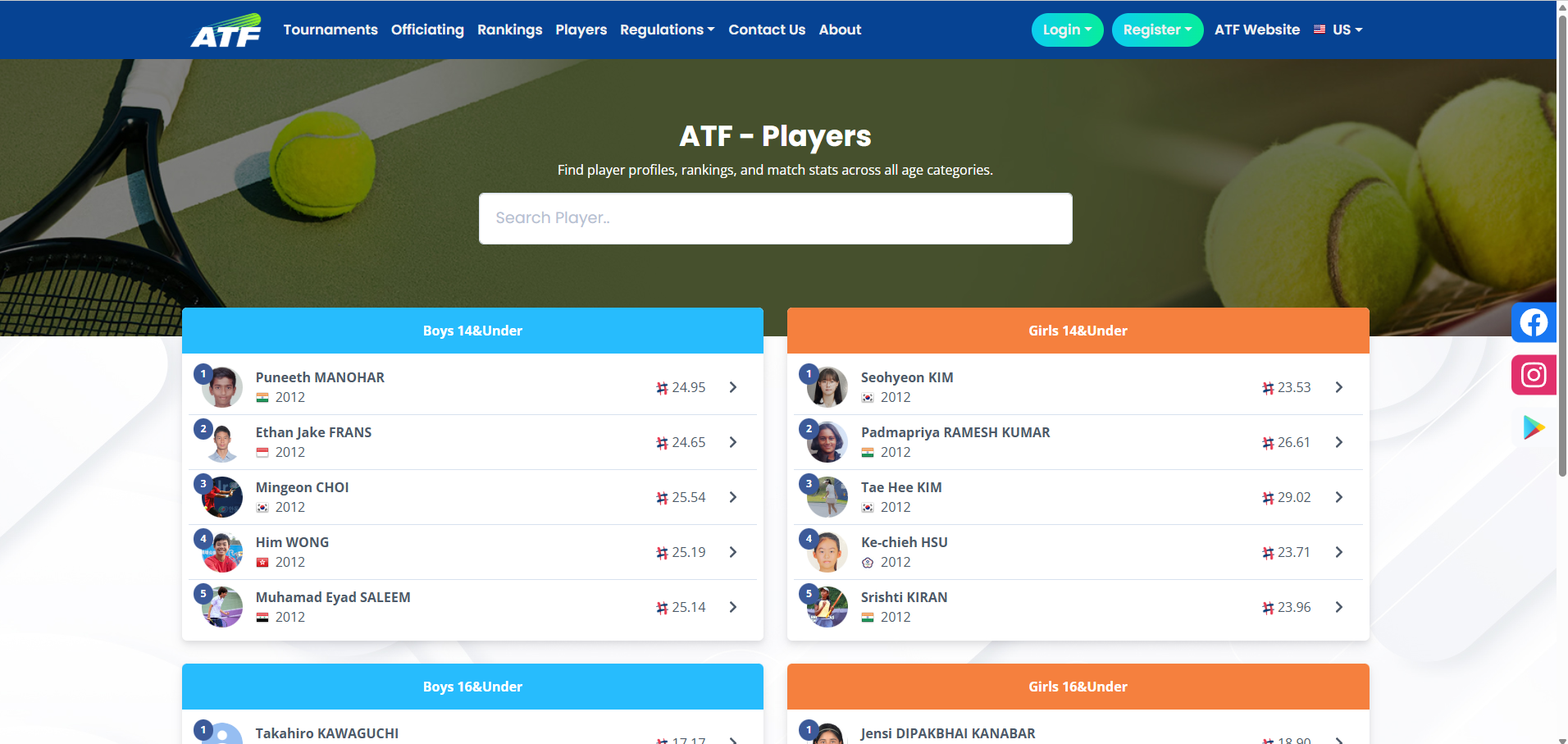
- Live Asian Tennis Federation rankings — browse the current week’s published rankings across all official categories.
- Sample player profile (Mingeon CHOI, ATF rank 3, 14U) — see how rankings, WTN, and match history are presented side-by-side on a live player record.
- Asian Tennis Federation Rankings: How Points Become Weekly Rankings — the companion piece on how points are computed, the 52-week rolling window, and the Warm Up points mechanic referenced above.
- ATF 14 & Under Regulations 2026 (PDF) — the formal regulation document covering category eligibility, ranking computation, Warm Up points, and the operational rules referenced throughout.